How to Jump Start a Car: Easy Instructions for Beginners
Your car won’t start. You turn the key and hear nothing. Or maybe just a clicking sound. This happens to everyone at some point. A dead battery is one of the most common car problems.
Learning how to jump start a car can save your day. You won’t need to wait for help. You won’t miss your important meeting. This guide shows you exactly what to do. We keep it simple and clear.
Jump starting takes about 10 minutes. You need another car or a jump starter device. The process is safe when you follow the right steps. Let’s get your car running again.
Why Batteries Die
Batteries give power to start your engine. They run lights and radio too. But they don’t last forever.
Common reasons your battery dies:
- Headlights stayed on all night.
- Cold weather kills battery power.
- Your battery is too old (3-5 years).
- Dirty white stuff on terminals.
- Bad alternator won’t charge it.
- Only short drives around town.
- Something drains power when parked.
Quick Battery Facts:
Car batteries are 12 volts. They weigh 30-50 pounds. Size is about 10 inches long and 7 inches tall.
Small cars need 400-600 amps to start. Trucks need 600-850 amps.
Red covers the positive (+) terminal. Black covers the negative (-) terminal.
What You Need for Jump Starting
Get these items before you start.
Jumper Cables:
- Get cables at least 12 feet long .
- Look for 4-gauge or 6-gauge thickness (thicker is better) .
- Make sure the clamps are heavy and grip well .
- Red cables connect to positive terminals .
- Black cables connect to negative terminals .
- Good cables have thick rubber coating .
- They should handle 400-600 amps safely.
Power Source:
- Another car with good battery.
- Portable jump starter box.
- Battery charger with jump feature.
Safety Gear:
- Safety glasses protect your eyes .
- Gloves keep your hands safe .
- A flashlight helps you see in the dark.
- Your car’s owner manual shows battery location.
How to Jump Start a Car
Follow these steps exactly. Order matters.
Step 1: Park the Cars
Move the working car close to yours. Batteries should be near each other. Don’t let cars touch.
Put both in Park. Pull parking brakes. Turn everything off. Lights, radio, AC – all off.
Step 2: Find the Batteries
Open both hoods. Look for batteries. Most are in the engine area.
Each battery has two posts:
- Positive (+) with red cap
- Negative (-) with black cap
- Remove caps if there
- Clean if you see white crusty stuff
Step 3: Connect Cables
This is the main step. Do it right.
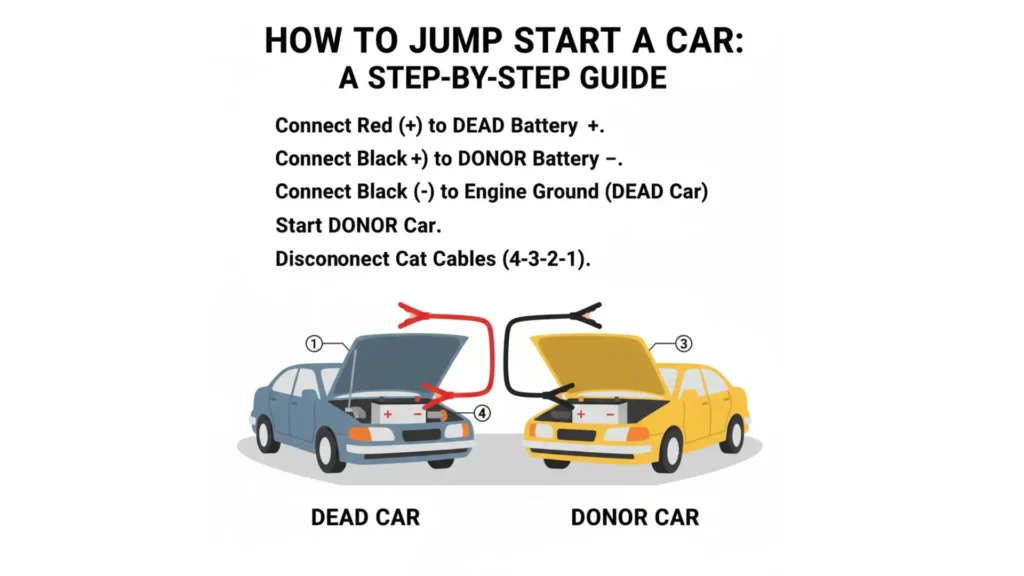
Here’s the order:
- Red cable to dead battery positive (+).
- Other red end to good battery positive (+).
- Black cable to good battery negative (-).
- Other black end to metal on dead car’s engine.
Don’t connect the last black clamp to the dead battery. Find clean metal on the engine instead. This keeps you safe.
Step 4: Start Helper Car
Start the car with good battery. Let it run for 3-5 minutes. This charges your dead battery.
Press gas pedal gently if you want. Not required though.
Step 5: Start Your Car
Try starting your car now. Turn the key. Hold for 3-5 seconds only.
If it doesn’t start:
- Wait 3 more minutes.
- Check all cable connections.
- Make sure clamps grip tight.
- Try again
- After 3 tries, call for help.
Step 6: Remove Cables
Car started? Great. Now remove cables backwards.
- Black from your engine
- Black from helper car
- Red from helper car
- Red from your car
Don’t let clamps touch each other. Don’t touch metal with them.
Step 7: Drive Around
Keep your engine running. Drive for 20-30 minutes. This recharges your battery.
Highway driving works best. Turn off radio and AC. Save power for the battery.
Using Portable Jump Starters
These small boxes are handy. No other car needed.
What They Are:
Battery packs that fit in your trunk. Size of a book. Weight 1-3 pounds. They hold power for jump starts.
Why People Buy Them:
- No other car needed.
- Small and easy to store.
- Works multiple times.
- Charges phones too.
- Very safe to use.
- Some have air pumps.
- Built-in flashlights.
How to Use:
Connect red to positive. Connect black to negative. Turn the box on. Wait 30 seconds. Start your car. Remove the box right away.
Keep it charged in your trunk. Recharge after each use.
Safety Rules You Must Follow
Batteries are dangerous if mishandled. Follow these rules.
Safety Rules:
- No smoking near batteries.
- Wear safety glasses always.
- Check cables for damage.
- Don’t touch clamps together.
- Take off jewelry and watches.
- Keep children away.
- Never jump frozen batteries.
- Stop if you smell rotten eggs.
- Don’t touch swollen batteries.
- Get help if battery leaks.
Cold weather makes batteries weak. They lose half their power at 0°F. Hot days over 100°F hurt them too.
After Jump Starting
Your car runs again. Good. But you’re not done.
Do This Now:
Drive to auto parts store. Get free battery test. They check if it’s still good. Test the alternator too.
Check battery age. Look for sticker with date. Replace batteries over 4 years old.
Keep Battery Healthy:
- Clean terminals every few months.
- Mix baking soda and water for cleaning.
- Tighten connections.
- Check for cracks
- Test twice a year
- Take longer drives weekly
Bad Battery Signs:
- Slow engine crank
- Dim headlights
- Dashboard battery light on
- Sulfur smell
- Puffy battery case
- Need frequent jump starts
When It Doesn’t Work
Sometimes jump starting fails. Here’s why.
Battery Too Dead:
Some batteries can’t be saved. Dead for weeks? It’s ruined inside. Buy new battery.
Bad Alternator:
This charges your battery while driving. If broken, car dies again fast. Mechanic must fix it.
Dirty Terminals:
White crusty buildup blocks power. Clean with wire brush. Use baking soda water. Try jump start again.
Blown Fuse:
Check fuse box. Look for burnt fuses. Owner manual shows location. Replace bad fuses.
Dead Starter Motor:
You hear clicks but engine won’t turn. Starter is broken. Need mechanic repair.
Other Problems:
- Out of gas
- Bad ignition switch
- Security system issue
- Engine seized up
Preventing Dead Batteries
Avoid the problem completely. Here’s how.
Regular Care:
See mechanic once yearly. Test battery before winter. Replace weak batteries early. Prevention beats repairs.
Smart Driving:
Take longer drives weekly. Short trips don’t charge fully. Drive 20-30 minutes regularly.
Use battery maintainer if you only drive short trips. Plugs into outlet. Keeps battery topped up.
Good Parking:
Park in garage during extreme weather. No garage? Use shade in summer. Battery blankets help in winter.
Common Mistakes
Don’t make these errors.
Wrong Cable Order:
Biggest mistake ever. Causes sparks and explosions. Always follow the exact order shown above.
Touching Clamps:
Never let red and black clamps touch. Creates dangerous short circuit. Melts cables. Damages batteries.
Rushing It:
Give dead battery time to charge. Wait 3-5 minutes minimum. Patience works better.
No Safety Gear:
Always wear glasses. Batteries can explode. Acid can spray. Protect your eyes.
Buying a Jump Starter
Ready to buy one? Here’s what matters.
Power Needed:
Small cars: 400-600 amps
Medium cars: 600-1000 amps
Trucks: 1000+ amps
Buy more power than you need. Gives safety cushion.
Battery Size:
10,000 mAh = 2-3 jump starts
20,000 mAh = 5-10 jump starts
30,000 mAh = 15-20 jump starts
Good Features:
- Strong clamps that grip well.
- Thick cables.
- Hard protective case.
- Reverse polarity protection.
- Built-in flashlight.
- USB phone charging.
- Charge level display.
Price Guide:
Basic: $40-$70 for small cars
Mid-range: $70-$120 for most cars
Premium: $120-$200 for trucks
Different Vehicles
Not all cars are the same.
Hybrids:
Have regular 12-volt battery. Jump start normally. But don’t use hybrid to jump other cars. Can damage system.
Diesels:
Need more power to start. Use heavy-duty cables. Give 5-10 minutes charging time.
Trucks:
Some use 24-volt systems. Need special equipment. Can’t jump from regular car.
Motorcycles:
Small batteries. Don’t jump from car. Use motorcycle jump starter only.
Real Situations
Quick answers to common problems.
Cold Morning:
Car won’t start at 20°F. Ask neighbor for help. Give 5-7 minutes charging in cold. Drive to work. Test battery at lunch.
Shopping Mall:
Dead in parking lot. Use portable jump starter if you have one. No starter? Ask security for help. They usually have equipment.
Lights Left On:
Left headlights on overnight. Battery just needs charging. Jump start and drive 30 minutes. Battery should be fine.
Old Battery:
Three jump starts this month. Battery is 5 years old. Stop jump starting. Buy new battery today.
Conclusion
Jump starting a car is easy once you know how. Keep cables or jump starter in your trunk. Test your battery twice yearly and clean terminals regularly. Remember the cable order: red to dead positive, red to good positive, black to good negative, black to ground. Three failed attempts means call for help. Replace any battery over 4 years old. Now you can handle dead batteries without stress or waiting for help.