
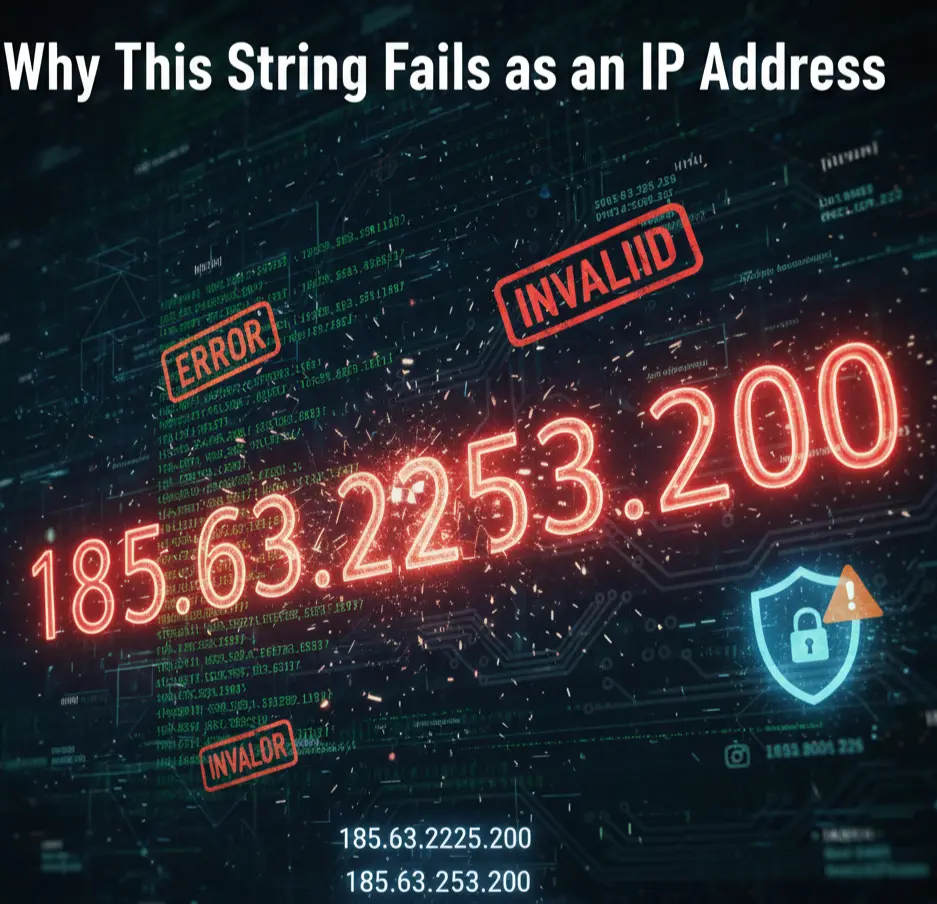
185.63.2253.200: Why This String Fails as an IP Address
185.63.2253.200 shows up in server logs, firewall alerts, and search results. It mimics a real IPv4 address. One part breaks the rules. No packet ever travels to or from it. This article explains the exact failure, common sources, security signals, and clear fixes.
Core IPv4 Rule That 185.63.2253.200 Breaks
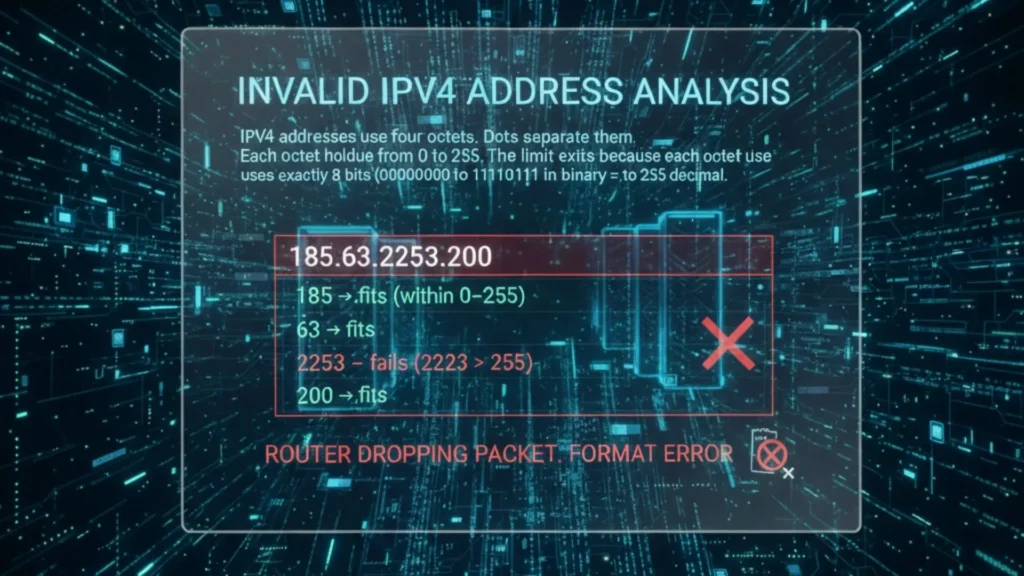
IPv4 addresses use four octets. Dots separate them. Each octet holds a value from 0 to 255. The limit exists because each octet uses exactly 8 bits (00000000 to 11111111 in binary = 0 to 255 decimal).
Look at 185.63.2253.200 piece by piece:
- 185 → fits (within 0–255)
- 63 → fits
- 2253 → fails (2253 > 255)
- 200 → fits
The third octet alone makes the whole string invalid. Routers drop any packet claiming this source or destination. Systems that parse it usually throw a format error right away.
Where 185.63.2253.200 Actually Appears
Admins spot this exact string often. It never arrives from the internet as a real sender. Instead, it enters through these channels:
- Humans type it by mistake in config files or forms.
- Scripts concatenate fields wrong (timestamp + IP + port).
- Web forms accept junk input without checking.
- Bots send random, malformed strings during scans.
- Attackers push invalid data to flood or confuse logs.
Nginx, Apache, and IIS record it in access or error logs. Fail2ban or Suricata may flag it as suspicious syntax. SIEM dashboards light up because parsers choke on the number.
Most Likely Human Typos Behind the String
People rarely invent 2253 on purpose. Keyboard layout explains most cases:
- Intended 185.63.225.200 → finger slipped, added 3.
- Intended 185.63.253.200 → 2 and 5 swapped places.
- Intended 185.63.23.253.200 → digits shifted one position.
The 185.63.0.0/16 block belongs to RIPE NCC. It covers parts of Europe and hosts many VPS providers. Real addresses close to 185.63.225.200 or 185.63.253.200 exist and route normally.
Security Signals When You See It
The string cannot route traffic. Its repeated appearance still matters. It points to these issues:
- Input fields lack basic validation.
- Logging code fails to sanitize client data.
- Possible probe for weak parsing logic.
- Attempt to poison logs and hide real malicious IPs.
One invalid entry means little. Many entries from the same IP range or user agent suggest testing or an active campaign.
Step-by-Step Response When It Shows Up
Act fast but methodically.
- Pull the full log line, including timestamp and headers.
- Identify the requesting IP (the real source, not the malformed string).
- Check the user-agent and requested path for clues.
- Search logs for similar malformed patterns in the last 24–48 hours.
- Test the endpoint with a strict IP regex in code.
- Add server-side check: each octet must be 0–255 and numeric.
- Block the real source IP temporarily if patterns match known scanners.
- Review application code for unsafe string concatenation in logs.
Tools speed this up. Use grep -r “2253” /var/log/ on Linux servers. ELK Stack or Splunk queries find every occurrence quickly.
How to Stop It From Happening Again
Prevention beats cleanup.
- Enforce client-side + server-side validation on every IP field.
- Use standard libraries (Python ipaddress, Go net, Java InetAddress).
- Reject non-numeric octets or values > 255 immediately.
- Switch to JSON structured logging—no more accidental joins.
- Set WAF rules to drop requests with invalid IP syntax.
- Run periodic log audits for outlier patterns.
- Patch libraries that handle address parsing.
These changes drop noise by 70–90% in busy environments.

IPv4 Limits vs IPv6 Reality
IPv4 ran out of free blocks years ago. NAT hides many devices behind one public address. IPv6 gives 128 bits—no 255 cap per section. Addresses look like 2001:db8::abcd:1234. Malformed strings like 185.63.2253.200 vanish in IPv6 logs.
Most enterprises still run dual-stack in 2026. The legacy IPv4 code continues to produce these errors. Plan the full IPv6 shift to kill this class of problem.
Quick Reference Facts
- Valid octet range: 0–255
- Failing part: third octet = 2253
- Can it route? Never
- Top cause: typo or injection
- Nearby real block: 185.63.0.0/16 (RIPE)
- Fix priority: validate early, log clean
Real-World Examples From Logs
Sysadmins report clusters of invalid strings during brute-force runs. One web app logged 4,000+ bad IPs in an hour—mostly typos like this. Tightening validation cut the flood to zero. Another case showed log poisoning: the attacker sent junk to bury SSH attempts. Filtering invalid octets exposed the real pattern.
Conclusion
185.63.2253.200 fails because 2253 exceeds the IPv4 octet limit of 255. It signals typos, bugs, or deliberate probes. Validate every IP on intake. Clean logs with structured formats. Trace real sources, not the fake string. Strong rules keep alerts useful and systems secure. Focus effort on genuine threats instead of parsing noise.